
The Natural Habitat of Animation
If you were designing an art form specifically optimized for the short film format, you might well invent animation. The medium’s core characteristics — its labor-intensive frame-by-frame construction, its freedom from the physical constraints of live-action filmmaking, its capacity for visual abstraction and transformation — align so precisely with the demands of short-form storytelling that the relationship feels less like a coincidence than a natural law.
Animation has thrived in the short form since the earliest days of cinema. Before Snow White and the Seven Dwarfs proved that audiences would sit still for eighty minutes of drawings in motion, animation was synonymous with the short. The Fleischer brothers, the early Disney shorts, the Looney Tunes and Merrie Melodies — these were the dominant expressions of the medium, and they operated at lengths between six and twelve minutes with a formal inventiveness that still astonishes.
The feature-length animated film eventually became the industry standard, driven by the economics of theatrical distribution and the audience-building machinery of studios like Disney, Pixar, and their global competitors. But the animated short never went away. It adapted, evolved, and — in many respects — outpaced its feature-length counterpart in formal innovation and thematic ambition.
Why Twenty Minutes Is the Sweet Spot
Animation is slow. This is not a criticism but a material fact. A traditionally animated film requires twelve to twenty-four drawings per second of screen time. A stop-motion film requires the physical manipulation of objects for every individual frame. Even digital animation, which has dramatically accelerated certain aspects of production, remains orders of magnitude more labor-intensive per minute of screen time than live-action filmmaking.
This production reality creates a natural economic incentive for short-form work. A ten-minute animated short can be produced by a small team — sometimes a single artist — over a period of months. A ninety-minute animated feature requires dozens or hundreds of artists working over years, with budgets that start in the millions and frequently reach the tens or hundreds of millions.
But the economic argument, while real, is only part of the story. Animation thrives in the short form for aesthetic reasons that have nothing to do with budgets. The medium’s greatest strength — its ability to create worlds, characters, and visual logics that are impossible in live action — reaches its fullest expression when deployed with precision rather than at length.
Consider the challenge facing a feature-length animated film. Over ninety minutes, the audience must inhabit an artificial world consistently enough for emotional investment to take hold. The visual rules of the world must remain stable enough to be legible. Characters must behave with enough consistency for their arcs to be believable. These requirements push feature animation toward a kind of visual realism — not photorealism, necessarily, but an internal consistency that limits how far the medium can deviate from established visual logic within a single film.
A ten-minute animated short faces none of these constraints. It can change visual styles mid-film. It can shift between abstraction and representation. It can abandon perspective, gravity, anatomy, and the laws of physics without losing the audience, because the audience has not been asked to invest in a stable world for ninety minutes. They have been asked to enter a visual experience for ten minutes and to trust the filmmaker’s choices. This trust is easier to grant — and easier to reward — at short length.
The Hand-Drawn Renaissance
Feature animation has moved decisively toward digital production. The last major hand-drawn animated feature from a Hollywood studio was Disney’s The Princess and the Frog in 2009. Hayao Miyazaki’s Studio Ghibli remains the most prominent holdout, and even Ghibli has incorporated digital elements into its production pipeline.
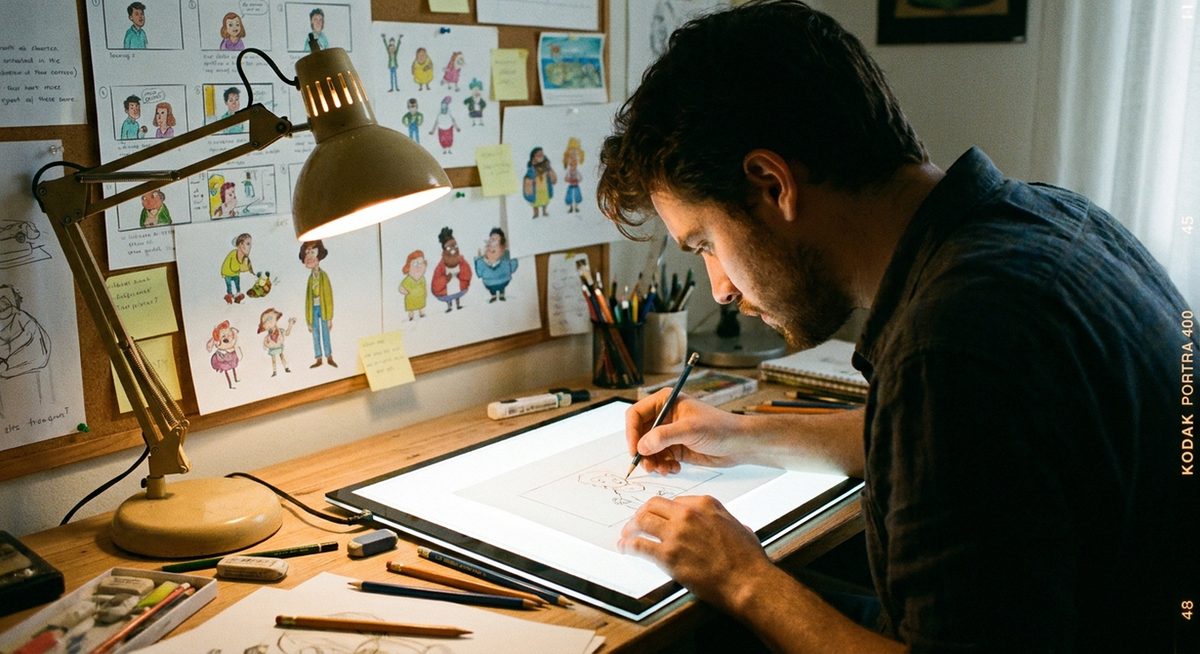
In the short form, hand-drawn animation is not merely surviving — it is experiencing a renaissance. Independent animators around the world continue to produce hand-drawn shorts that exploit the medium’s distinctive qualities: the visible presence of the artist’s hand, the organic imperfection of drawn lines, the emotional warmth that comes from knowing that a human being labored over every frame.
The hand-drawn animated short has become a site of resistance against the homogenizing tendencies of digital production. Where feature animation studios converge on a small number of visual styles — the Pixar look, the Ghibli look, the Spider-Verse look — hand-drawn shorts express as many visual identities as there are artists making them. Each film carries the fingerprint of its creator in a way that digitally produced work, for all its sophistication, struggles to match.
Stop-Motion: The Intimate Art
Stop-motion animation occupies a unique position in the short film landscape. The technique — photographing physical objects one frame at a time, making minute adjustments between exposures — is inherently slow, inherently tactile, and inherently at odds with the efficiency-driven logic of commercial animation production.
These limitations make stop-motion difficult to sustain at feature length. The production timeline for a stop-motion feature is measured in years, and the budgets, while lower than those for digital features, are still substantial. Laika, the most prominent stop-motion feature studio, takes three to four years per film and operates at budgets of fifty to seventy million dollars.
In the short form, stop-motion becomes accessible. A single animator with a workbench, a camera, and sufficient patience can produce a stop-motion short of extraordinary quality. The physical nature of the medium — the fact that the objects on screen exist in three-dimensional space, that they have weight, texture, and the slight imperfections of handmade things — gives stop-motion shorts a tactile quality that digital animation cannot replicate.
The Academy Award for Best Animated Short Film has been won by stop-motion films with notable frequency, reflecting the technique’s particular suitability for the format. Films like Adam Elliot’s Harvie Krumpet and Suzie Templeton’s Peter and the Wolf demonstrate what stop-motion can achieve in the short form: emotional narratives rendered in physical materials, where the visible craft of the production becomes part of the viewer’s experience.
Experimental Animation and the Festival Circuit
The animated short has long been the primary home for experimental approaches to the moving image. Work that pushes the boundaries of what animation can be — direct animation on film stock, projection mapping, generative algorithmic animation, films made from sand, paint, charcoal, or found objects — finds its audience almost exclusively through the short film format and the festival circuit that supports it.
Festivals like Annecy, Ottawa, Zagreb, and Hiroshima maintain dedicated programs for experimental animated shorts, providing a curatorial context in which audiences are prepared to engage with work that defies conventional narrative and visual expectations. These festivals also serve as nodes in a global community of experimental animators, facilitating the exchange of techniques, ideas, and mutual inspiration that sustains the field.
The relationship between experimental animated shorts and the commercial animation industry is more productive than it might appear. Techniques pioneered in experimental shorts routinely migrate into commercial production — the mixed-media approaches of Spider-Man: Into the Spider-Verse, for instance, owe a clear debt to decades of experimental animated shorts that combined hand-drawn, digital, and photographic elements. The short form serves as the R&D department of the animation industry, testing visual and narrative strategies that may eventually be adopted at scale.
The Emotional Register of Animated Shorts
There is a persistent misperception that animation is primarily a medium for children’s entertainment. This perception, while fading, continues to shape audience expectations and funding priorities in ways that disadvantage animated work aimed at adult audiences.
The animated short has done more to challenge this perception than any other format. Films like Don Hertzfeldt‘s World of Tomorrow — which uses crude stick figures to explore consciousness, mortality, and the commodification of memory — demonstrate that animation can address the most complex and emotionally demanding themes with a directness that live action sometimes cannot match.
The medium’s capacity for abstraction is key to its emotional range. A drawn character can express grief, joy, confusion, or rage through distortions of form that would be impossible for a human actor. A line can thicken with anger. A color palette can shift with mood. The laws of physics can bend to accommodate emotional logic rather than physical logic. These capabilities are available to animation at any length, but they are deployed most effectively in the short form, where the filmmaker can calibrate the emotional arc with frame-level precision.
Animated shorts regularly address themes that commercial feature animation avoids: mental illness, addiction, political violence, sexuality, death. The format’s lower production costs and smaller distribution footprint reduce the commercial risk of engaging with difficult subject matter. A ten-minute animated short about depression does not need to recoup a hundred-million-dollar investment. It needs only to reach the audience for whom it will matter.
The Digital Democratization
Digital tools have transformed the production landscape for animated shorts. Software that would have cost thousands of dollars a decade ago is now available for free or near-free. Drawing tablets have become affordable. Rendering power that once required dedicated server farms is now available on consumer laptops. Online tutorials and communities have made self-education in animation techniques accessible to anyone with an internet connection.
This democratization has produced an explosion of animated short content. YouTube alone hosts millions of animated shorts, ranging from professional-quality productions to first experiments by teenage artists. The quality curve is steep — most of this work is, predictably, not very good — but the volume ensures that a significant number of exceptional films emerge every year from creators who would not have had access to the tools of animation production a generation ago.
The democratization has also expanded the geographic and cultural diversity of animated shorts. Where the field was once dominated by a handful of national industries — the United States, Japan, France, the United Kingdom, Canada — it now includes significant contributions from South Korea, China, India, Brazil, Iran, and across Africa. Each of these regions brings distinct visual traditions, storytelling conventions, and cultural perspectives that enrich the global conversation about what animated films can be and do.
Why the Short Form Will Always Be Animation’s Home
The animated feature film is a magnificent art form. The work of Miyazaki, of Pixar at its best, of Isao Takahata and Sylvain Chomet and the artists behind Persepolis and Waltz with Bashir, represents some of the highest achievements in cinema. But the animated feature, by economic necessity and audience expectation, operates within constraints that the animated short does not share.
The animated short is where the medium experiments. Where it takes risks. Where a single artist’s vision can be realized without the compromises that collaborative, high-budget production inevitably requires. Where the full range of animation’s expressive potential — from photorealistic simulation to the crudest line drawing — can be deployed in service of stories, ideas, and visual experiences that exist nowhere else in cinema.
The short film is not animation’s rehearsal space. It is animation’s home — the format where the medium reaches its most concentrated, most inventive, and most emotionally potent expression. Under twenty minutes, with a pencil and a camera and an idea, an animator can do things that no other artist in any other medium can match. That is not a limitation. That is a superpower.