
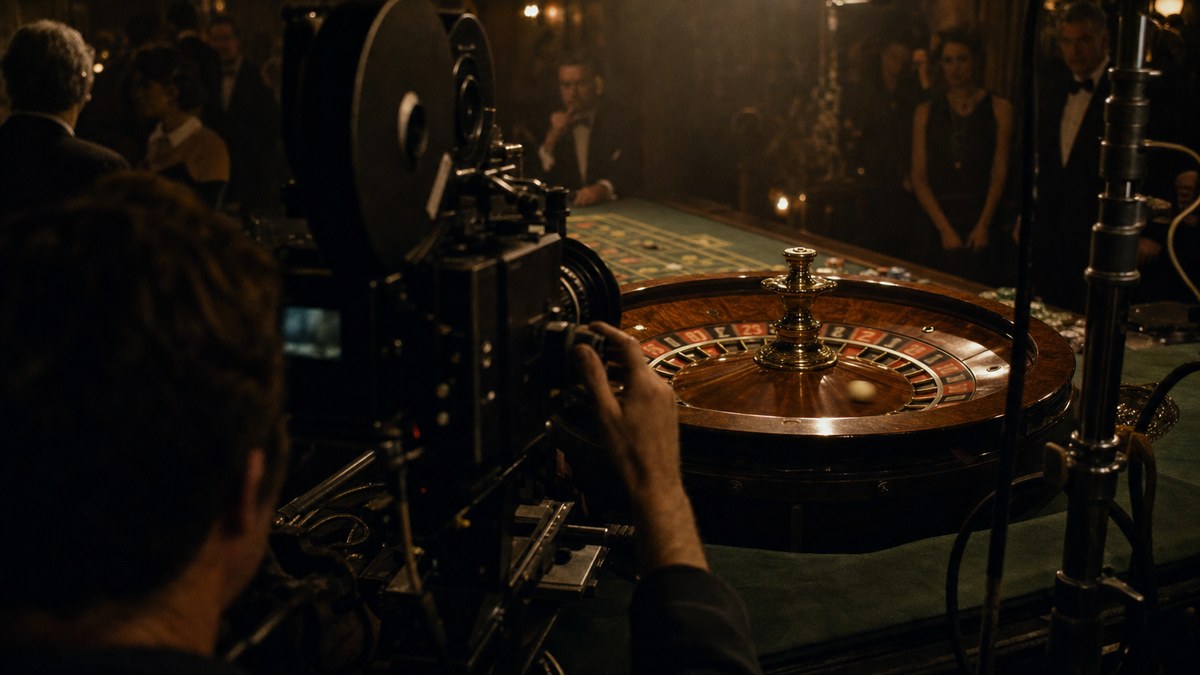
There are few objects in cinema as reliably eloquent as a roulette wheel. A director who wants to say everything is about to change doesn’t need dialogue — just a close-up of the ball skittering across the frets, a crowd holding its breath, and a cut to a face. The wheel is one of the medium’s great shorthand devices: circular, kinetic, indifferent. It photographs beautifully and it means the same thing in every language. Chance is in charge now.
A machine built for the camera
Part of the appeal is purely visual. Roulette gives a filmmaker motion inside a static frame — the spin, the counter-spin of the ball, the slow decay into stillness. Editors love it because the wheel supplies its own rhythm: acceleration, suspension, verdict. Michael Curtiz understood this in Casablanca, where Rick’s rigged roulette table becomes a quiet act of mercy, the wheel doing the moral work the character can’t say aloud. Half a century later, Tom Tykwer built the delirious final act of Run Lola Run around a single number, the camera whipping between Lola’s scream and the tumbling ball as though the film itself were being decided in real time.
Mike Hodges’ Croupier approaches the table from the other side, through the dealer’s cold eyes — a reminder that for the house, the wheel isn’t drama at all, just arithmetic wearing a tuxedo. That tension between how the player sees the wheel and how the house sees it is, in miniature, the tension of most gambling cinema.
Chance as character
What the wheel really offers storytellers is an honest antagonist. Unlike poker, roulette involves no bluffing, no skill, no reading of opponents. When a character puts everything on red, they aren’t outsmarting anyone — they’re submitting. That submission is dramatically pure, which is why the wheel so often appears at moments of surrender: to fate, to debt, to love, to self-destruction.
Short filmmakers have long understood that chance itself can carry a whole narrative. Jérémy Comte’s Oscar-nominated Fauve (2018) contains no casino, but it is essentially a film about a wager — two boys escalating a game of one-upmanship in a surface mine until the stakes become unpayable. It’s roulette logic stripped of the felt and the chips. Don Hertzfeldt’s work mines a similar vein from the opposite direction, treating the randomness of existence as both cosmic joke and genuine terror. And Patrick Vollrath‘s Everything Will Be Okay shows how a single irreversible decision — one spin, in effect — can power twenty minutes of nearly unbearable suspense.
The wheel in the wider culture
The game’s on-screen ubiquity mirrors its persistence off-screen. Roulette has been in continuous play since 18th-century Paris, and its migration from Monte Carlo salons to digital platforms has been widely documented — the growth of the best online roulette sites Canada now hosts has drawn regular mainstream press attention, according to ottawacitizen.com, as regulated markets like Ontario’s have brought the game to a far larger audience than any casino floor could hold. For historical grounding, the Encyclopaedia Britannica’s entry on roulette traces the wheel’s disputed origins, including the persistent (and probably apocryphal) legend that Blaise Pascal invented it while chasing a perpetual motion machine.
That history matters to filmmakers, too. The wheel arrives on screen pre-loaded with two centuries of association — aristocratic ruin, wartime intrigue, midnight desperation. A director doesn’t have to build that meaning; they inherit it, the way they inherit the meaning of a wedding ring or a loaded gun.
Where the game lives now
The roulette scene of 2026 looks different from the one Curtiz shot. The velvet rooms still exist, but the wheel increasingly spins on screens — live-dealer streams, mobile tables, virtual casinos rendered in engines that would have counted as visual effects a decade ago. Curiously, this hasn’t diminished its cinematic power. If anything, the game’s move online has given filmmakers a new image to work with: the solitary player, lit by a phone, watching a wheel spin somewhere in a studio in Riga or Vaughan. The crowd is gone; the submission to chance remains.
The short films that handle chance best are easier to find than ever, too — most of the titles mentioned here are streaming legally, and our guide to where to watch short films maps the current platforms.
For cinema, that’s the enduring gift of roulette. It’s not really about money. It’s about the moment a character stops steering — and the camera, like the ball, has nowhere to look but down.